
 https://doi.org/10.4081/crest.2026.52
Gastric/pancreatobiliary-type differentiation in colorectal adenocarcinoma: a rare and aggressive case in a young adult
All claims expressed in this article are solely those of the authors and do not necessarily represent those of their affiliated organizations, or those of the publisher, the editors and the reviewers. Any product that may be evaluated in this article or claim that may be made by its manufacturer is not guaranteed or endorsed by the publisher.
Published: 16 September 2026
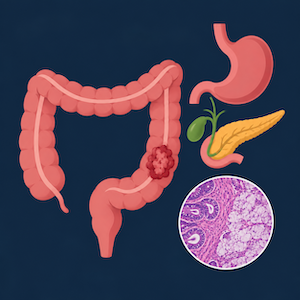
Colorectal cancer (CRC) is a leading cause of cancer-related morbidity and mortality worldwide. Although most CRCs exhibit a characteristic immunohistochemical profile, rare variants with unusual differentiation patterns can pose significant diagnostic challenges and carry an adverse prognosis. We report a case of an aggressive colorectal adenocarcinoma with gastric/pancreatobiliary-type differentiation in a young adult. A 29-year-old woman presented with a 2-year history of melena, constipation, fatigue, and weight loss. Imaging and colonoscopy revealed a circumferential stenosing sigmoid colon mass with suspected peritoneal involvement. Histopathological examination demonstrated a moderately to poorly differentiated adenocarcinoma. Immunohistochemistry showed an atypical profile for colorectal origin, with positivity for CK7, MUC1, and MUC5AC, and negativity for CK20, CDX2, SATB2, and MUC2. Mismatch repair proteins were intact, indicating microsatellite stability. Surgical exploration revealed locally advanced disease with direct invasion of adjacent small bowel, appendix, and abdominal wall. En bloc resection was performed, and final pathology confirmed pT4bN2b disease with lymphovascular invasion and extranodal extension. This case highlights a rare immunophenotypic subtype of colorectal adenocarcinoma that mimics gastric or pancreatobiliary differentiation. Recognition of this entity is essential to avoid misclassification as metastatic disease from an extraintestinal primary and to ensure accurate staging and management. Awareness of such aggressive variants is particularly important given their association with poor prognostic features despite young patient age.
Downloads
1. Morgan E, Arnold M, Gini A, et al. Global burden of colorectal cancer in 2020 and 2040: incidence and mortality estimates from GLOBOCAN. Gut 2023;72:338-44. DOI: https://doi.org/10.1136/gutjnl-2022-327736
2. Fei F, Li C, Cao Y, et al. CK7 expression associates with the location, differentiation, lymph node metastasis, and the Dukes' stage of primary colorectal cancers. J Cancer 2019;10:2510-9. DOI: https://doi.org/10.7150/jca.29397
3. Hrudka J, Fišerová H, Jelínková K, et al. Cytokeratin 7 expression as a predictor of an unfavorable prognosis in colorectal carcinoma. Sci Rep 2021;11:17863. DOI: https://doi.org/10.1038/s41598-021-97480-4
4. Zeng Y, Zhang Q, Zhang Y, et al. MUC1 Predicts Colorectal Cancer Metastasis: A Systematic Review and Meta-Analysis of Case Controlled Studies. PLoS One 2015;10:e0138049. DOI: https://doi.org/10.1371/journal.pone.0138049
5. Badia-Ramentol J, Gimeno-Valiente F, Duréndez E, et al. The prognostic potential of CDX2 in colorectal cancer: Harmonizing biology and clinical practice. Cancer Treat Rev 2023;121:102643. DOI: https://doi.org/10.1016/j.ctrv.2023.102643
6. Kim JH, Rhee YY, Bae JM, et al. Loss of CDX2/CK20 expression is associated with poorly differentiated carcinoma, the CpG island methylator phenotype, and adverse prognosis in microsatellite-unstable colorectal cancer. Am J Surg Pathol 2013;37:1532-41. DOI: https://doi.org/10.1097/PAS.0b013e31829ab1c1
7. Li C, Zuo D, Yin L, et al. Prognostic Value of MUC2 Expression in Colorectal Cancer: A Systematic Review and Meta-Analysis. Gastroenterol Res Pract 2018;2018:6986870. DOI: https://doi.org/10.1155/2018/6986870
8. Suriya RR, Suresh RSR, Eswari VEV. A Study of Expression of SATB2 Protein In Colorectal Adenocarcinoma And Its Correlation With Clinicopathological Parameters. J Neonatal Surg 2025;14:165-72. DOI: https://doi.org/10.63682/jns.v14i6.3063
9. Liu F, Gao Z, Shen D, et al. Significance of SATB2 expression in colon cancer and its differential diagnosis in digestive tract adenocarcinoma and ovarian primary and metastatic carcinoma. Pathol Res Pract 2019;215:152430. DOI: https://doi.org/10.1016/j.prp.2019.04.022
10. Rico SD, Höflmayer D, Büscheck F, et al. Elevated MUC5AC expression is associated with mismatch repair deficiency and proximal tumor location but not with cancer progression in colon cancer. Med Mol Morphol 2021;54:156-65. DOI: https://doi.org/10.1007/s00795-020-00274-2
11. Pothuraju R, Rachagani S, Krishn SR, et al. Molecular implications of MUC5AC-CD44 axis in colorectal cancer progression and chemoresistance. Mol Cancer 2020;19:37. DOI: https://doi.org/10.1186/s12943-020-01156-y
12. Bayrak R, Haltas H, Yenidunya S. The value of CDX2 and cytokeratins 7 and 20 expression in differentiating colorectal adenocarcinomas from extraintestinal gastrointestinal adenocarcinomas: cytokeratin 7-/20+ phenotype is more specific than CDX2 antibody. Diagn Pathol 2012;7:9. DOI: https://doi.org/10.1186/1746-1596-7-9
13. Issın G, Tok M, Çağatay DV, et al. Diagnostic challenge of primary colonic poorly cohesive adenocarcinoma exhibiting gastric‑type immunohistochemistry profile and focal signet‑ring differentiation. Pol J Pathol 2025;76:348-54. DOI: https://doi.org/10.5114/pjp.2025.159280
Ethics Approval
CRediT authorship contribution
Michail Skandalakis: conceptualization, data collection, writing – original draft, writing – review & editing; Georgios Kaklamanis: conceptualization, methodology, data collection, writing – review & editing; Lampros Siozos, Athina Kafritsa: data collection, writing – original draft, writing – review & editing; Pampos Ioannou, Paraskevi Axi, Maria Perroti: writing – original draft; Apostolos Angelakoudis: supervision; Alexandra Varlatzidou, Panagiotis Voulgaris, Vaios Primikiris: supervision, validation. All authors have read and approved the final version of the manuscript and agreed to be accountable for all aspects of the work.
Data Availability Statement
All data underlying the findings are fully available.
How to Cite

This work is licensed under a Creative Commons Attribution-NonCommercial 4.0 International License.
PAGEPress has chosen to apply the Creative Commons Attribution NonCommercial 4.0 International License (CC BY-NC 4.0) to all manuscripts to be published.
