
 https://doi.org/10.4081/crest.2026.59
A not-so-empty pelvis syndrome: a case report of the unusual use of a breast implant finding a new home
All claims expressed in this article are solely those of the authors and do not necessarily represent those of their affiliated organizations, or those of the publisher, the editors and the reviewers. Any product that may be evaluated in this article or claim that may be made by its manufacturer is not guaranteed or endorsed by the publisher.
Accepted: 4 October 2026
Published: 14 October 2026
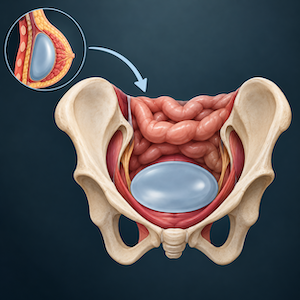
One complication of pelvic exenteration involving the removal of pelvic organs is empty pelvis syndrome (EPS). Following surgery, the empty space might cause fluid collection and small bowel adhesion to the pelvic floor, potentially leading to fistula formation, pelvic abscess, or chronic infection. To treat EPS, silicone breast prostheses are sometimes placed in the pelvic cavity. This technique is considered a simple and safe method for managing EPS, although it is not a common practice, and more research is needed to fully understand its efficacy and potential complications. We present the clinical case of an oncology patient who underwent a Hartmann’s colonic resection, in whom a breast implant was placed in the pelvic cavity to fill the empty space left by the surgical excision. The patient presented to the emergency department with abdominal pain, fever, rectal discharge suggestive of an enterorectal fistula, and symptoms of intestinal obstruction.
Downloads
PelvEx Collaborative. The empty pelvis syndrome: a core dataset from the PelvEx collaborative. Br J Surg 2024;111:znae042. Erratum in: Br J Surg 2024;111:znae095. DOI: https://doi.org/10.1093/bjs/znae095
Bernetti C, Buoso A, Beomonte Zobel B, Mallio CA. Complications after abdominal surgery and breast implant pelvic positioning: case report and literature review. Emerg Radiol 2023;30:691-6. DOI: https://doi.org/10.1007/s10140-023-02164-3
Hagemans JAW, Rothbarth J, Kirkels WJ, et al. Total pelvic exenteration for locally advanced and locally recurrent rectal cancer in the elderly. Eur J Surg Oncol 2018;44:1548-54. DOI: https://doi.org/10.1016/j.ejso.2018.06.033
Kusters M, Austin KK, Solomon MJ, et al. Survival after pelvic exenteration for T4 rectal cancer. Br J Surg 2015;102:125-31. DOI: https://doi.org/10.1002/bjs.9683
Johnson YL, West MA, Gould LE, et al. Empty pelvis syndrome: a systematic review of reconstruction techniques and their associated complications. Colorectal Dis 2022;24:16-26. DOI: https://doi.org/10.1111/codi.15956
Sutton PA, Brown KGM, Ebrahimi N, et al. Long-term surgical complications following pelvic exenteration: Operative management of the empty pelvis syndrome. Colorectal Dis 2022;24:1491-7. DOI: https://doi.org/10.1111/codi.16238
Valle M, Federici O, Ialongo P, et al. Prevention of complications following pelvic exenteration with the use of mammary implants in the pelvic cavity: Technique and results of 28 cases. J Surg Oncol 2011;103:34-8. DOI: https://doi.org/10.1002/jso.21716
Carboni F, Federici O, Giofrè M, et al. Empty pelvis syndrome: the use of breast prosthesis in the prevention of complications. Colorectal Dis 2019;21:1321-5. DOI: https://doi.org/10.1111/codi.14737
Hvilsom GB, Hölmich LR, Henriksen TF, et al. Local complications after cosmetic breast augmentation: results from the Danish Registry for Plastic Surgery of the breast. Plast Reconstr Surg 2009;124:919-25.
Breiting VB, Hölmich LR, Brandt B, et al. Long-term health status of Danish women with silicone breast implants. Plast Reconstr Surg 2004;114:217-26. DOI: https://doi.org/10.1097/01.PRS.0000128823.77637.8A
How to Cite

This work is licensed under a Creative Commons Attribution-NonCommercial 4.0 International License.
PAGEPress has chosen to apply the Creative Commons Attribution NonCommercial 4.0 International License (CC BY-NC 4.0) to all manuscripts to be published.
